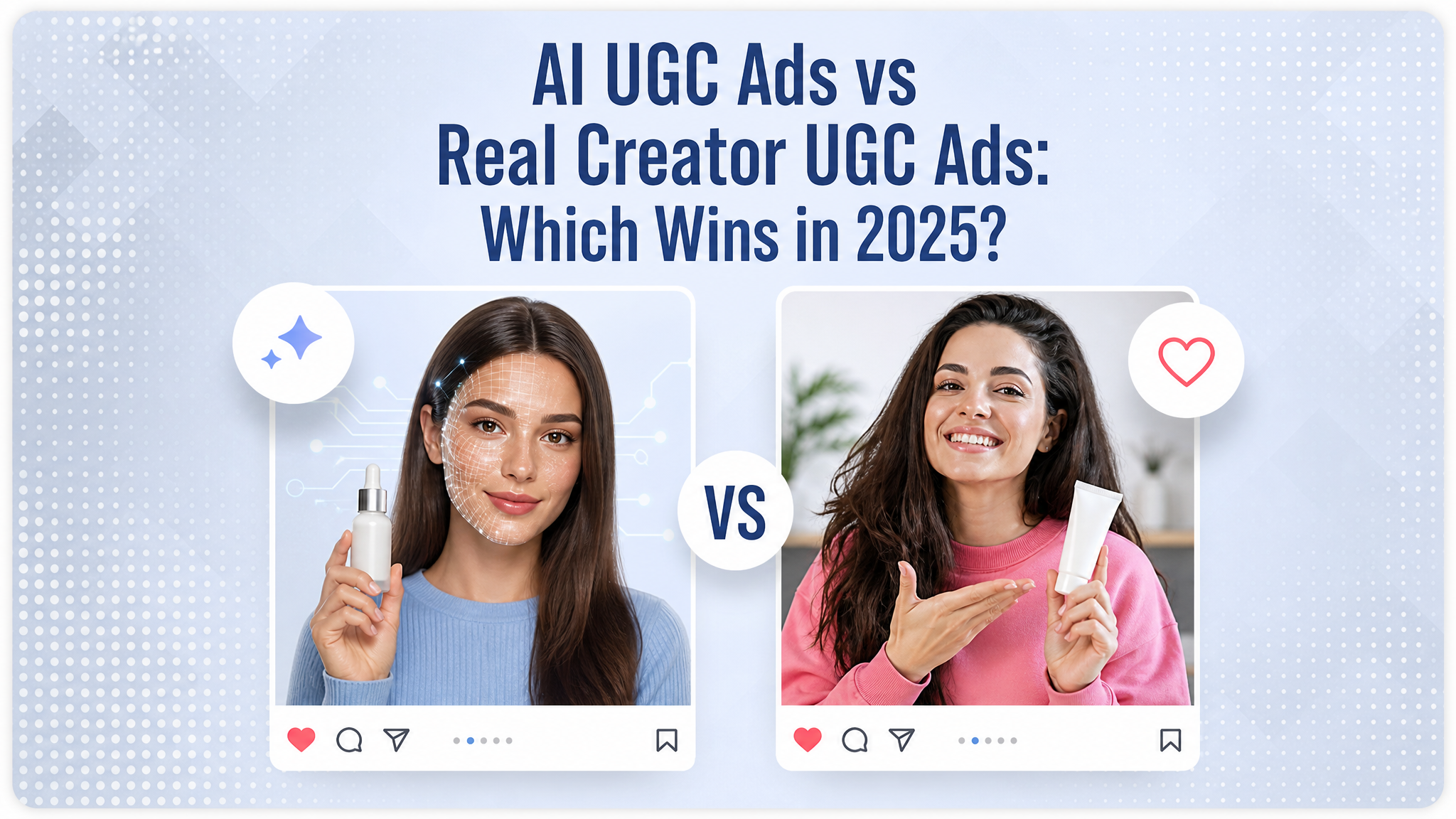
If you've been comparing tools like arcads.ai, creatify.ai, ugcads.ai, or createugc.ai, you're probably trying to answer one question: can an AI avatar actually replace a real creator in a UGC ad? We run UGC campaigns for a living, so this isn't another tool pitch dressed up as a comparison — it's a look at where AI-generated UGC genuinely holds up, where it doesn't, and why most brands running paid campaigns still end up back with real creators.
Contents
- What Is AI UGC Advertising?
- How Do AI UGC Tools Actually Work?
- Where AI-Avatar Tools Fall Short
- When Does AI UGC Actually Work Well?
- When Real Creator UGC Ads Outperform AI Avatars
- The Hybrid Approach
- How to Choose: A Quick Decision Framework
- Why Brands Choose Real UGC Creators Over AI Avatars
- FAQs: AI UGC Ads vs Real Creator UGC Ads
What Is AI UGC Advertising?
AI UGC ads are short-form video ads generated using AI avatars and synthetic voice instead of filming a real person holding or using a product. A script goes in, an AI-rendered "creator" delivers it on screen, and a finished ad comes out — often in minutes.
This is the category that tools like arcads.ai, creatify.ai, ugcads.ai, and createugc.ai have built entire products around, many with free or freemium tiers that let you generate a handful of ads before hitting a paywall. If you searched "ugc ads ai free" or "ugc ads free" expecting a rundown of what these tools actually offer, that's exactly it: script-to-video generation, no camera, no creator booking, no filming logistics. For a brand testing ad concepts on a tight budget, that's a genuinely useful proposition — the question is what you give up to get there.
How Do AI UGC Tools Actually Work?
The workflow is fairly consistent across the major players. You write or paste in a script — usually a hook, a problem statement, and a call to action, the same structure a real UGC brief would use. You then pick an AI avatar from a library of synthetic "creators," choose a voice (often cloned or synthesized to match a tone or accent), and the tool renders a video combining the avatar's lip movements, voice track, and sometimes on-screen product placement or b-roll.
Some tools let you upload your own product images to composite into the scene; others rely entirely on stock-style avatar templates. Turnaround is fast — often under ten minutes per video — which is the entire selling point. There's no briefing a creator, no waiting on raw footage, no editing back-and-forth. Understanding this pipeline matters before judging it, because the weaknesses that show up later come directly from how the video is assembled, not from the concept being flawed.
Where AI-Avatar Tools Fall Short — What arcads.ai, Creatify, and Others Don't Tell You
Every one of these tools is marketed as a near drop-in replacement for real creator UGC. What none of their landing pages mention is where that substitution actually breaks down.
The first issue is authenticity signals — the small cues viewers and platforms both pick up on. AI avatar voices can still sound synthetic to viewers, particularly on longer scripts where cadence and emphasis need to shift naturally. Lip-sync artifacts, subtle but noticeable, show up more often on close-up talking shots than on the wide, hand-held angles typical of real UGC. Avatar faces, even from the better tools, tend to cluster around a handful of recognizable "types" — viewers who watch a lot of ads on a platform start to recognize the same synthetic face across different brands, which undercuts the entire premise of UGC feeling personal and unscripted.
The second issue is genuine product interaction. Real UGC works because a creator is actually holding, applying, tasting, or unboxing something — the imperfect, unscripted moment is the trust signal. An AI avatar can gesture toward a product render, but it can't genuinely react to a texture, a taste, or an unboxing surprise, because there's nothing there to react to. That gap matters more for some categories than others, which we'll get into below.
There's also a platform-level risk worth naming directly: platform policies on AI-generated ad content are tightening, with disclosure requirements emerging for synthetic media in ads. A brand that leans entirely on AI avatars without factoring in disclosure rules is taking on a compliance risk that none of the tool vendor pages address, because it's not in their interest to.
When Does AI UGC Actually Work Well?
None of this makes AI UGC useless — it has a real place in a testing workflow, and dismissing it outright would be its own kind of bias.
- Rapid hook testing. Running ten variations of an opening line to see which one stops the scroll is exactly what AI generation is fast enough for, and paying a real creator to reshoot ten hook variants isn't a good use of budget at that stage.
- Low-budget top-of-funnel awareness. For broad-reach brand awareness spend where the bar for "authentic" is lower than for a direct-response conversion ad, AI UGC can fill volume affordably.
- Internal concepting before a real shoot. Storyboarding a script as an AI-generated rough cut, then handing the validated concept to a real creator for the actual production, saves creative back-and-forth without wasting a creator's time on an unproven idea.
- Speed-over-authenticity markets. Some categories and geographies genuinely reward speed and volume over polish — commoditized, low-consideration products where the ad's job is simple reach, not building trust in a considered purchase.
When Real Creator UGC Ads Outperform AI Avatars
The clearest way to think about this is by purchase consideration level. The more a buyer needs to trust a product before purchasing, the more a genuine human reaction matters — and the more AI avatars tend to underperform.
For considered or high-trust categories — skincare, supplements, finance, anything involving the body or money — a viewer is unconsciously screening for signs the person on screen is real and has actually used the product. Platform algorithms also tend to favor content that reads as organic engagement rather than polished ad creative, and a genuine creator reaction, awkward pause included, reads as organic in a way a synthetic avatar generally doesn't.
Real creators also bring something no avatar library can replicate: an existing audience and a track record, which functions as social proof independent of the ad itself. And there's no synthetic-media backlash risk — a real creator can't trigger the kind of "wait, is this AI?" comment thread that erodes trust in a brand overnight.
We've seen this play out directly in campaign results rather than as a general claim. Neolayr's UGC campaign that drove a 12% conversion boost pulled in over 5.2 million views using real creators specifically because the product — a Vitamin C serum — needed a genuine, visible skin reaction to build buyer trust, something no avatar render could substitute for. Similarly, Organic India's herbal blends UGC campaign lifted engagement by 12% on a product category where authenticity around taste and ingredient trust was the entire point of the campaign.
If you're newer to this space, it's worth understanding what UGC creators actually are before deciding which route fits your brand — the value real creators bring isn't just the video, it's the person behind it.
The Hybrid Approach: Where AI and Real Creators Work Together
The false choice in most of the AI-vs-real debate is that you have to pick one. In practice, the strongest workflow we run for clients uses both, at different stages.
We start by generating several script and hook variations through AI UGC tools — fast, cheap, and disposable if they don't land. We run those variants through low-spend testing to see which hook, angle, or pacing actually gets attention. Once a concept proves itself in that cheap testing phase, we hand the winning script to a real creator to produce the version that actually goes into paid scaling. The AI layer becomes a fast, low-risk filter for creative direction; the real creator layer becomes the version that carries the weight of the actual ad spend.
This matters because it solves the real problem with each approach in isolation: AI avoids wasting creator time and budget on unproven scripts, and real creators avoid putting a synthetic face in front of the exact audiences — considered-purchase buyers — where authenticity determines conversion. If you also want a platform-specific version of this, how we run winning TikTok UGC campaigns walks through how the same testing logic applies specifically to TikTok's algorithm and format.
How to Choose: A Quick Decision Framework
- Budget-constrained, early-stage testing, low-consideration product → AI UGC tools are a reasonable starting point.
- High-trust or considered purchase (skincare, supplements, finance, health), or you're about to put real paid spend behind an ad → real creator UGC.
- You need both speed in testing and authenticity in the final asset → the hybrid workflow: AI for hook testing, real creators for the scaled version.
- You're unsure which of your existing scripts would even work as a real shoot → this is exactly what the hybrid model above is built to de-risk.
Why Brands Choose Real UGC Creators Over AI Avatars for Paid Campaigns
Once a brand is ready to put actual media spend behind an ad — not just testing a concept — the calculation shifts firmly toward real creators. The measurable results back this up directly: the Neolayr campaign's 12% conversion boost and Organic India's 12% engagement lift weren't incidental outcomes, they were the direct product of using real people whose reactions and product handling read as credible to the audiences those campaigns targeted.
If your product needs a buyer to trust a stranger's genuine experience before they'll purchase — which describes most considered-purchase categories — that trust is the entire value real creators add, and it's the piece AI avatars are structurally unable to replicate. If you want to see how that plays out for your product, our UGC Ads production services walks through how we brief, produce, and scale real-creator campaigns end to end. And if you're building your own UGC pipeline in-house first, how to create UGC content from your audience is a useful next read before you commit budget either way.
FAQs: AI UGC Ads vs Real Creator UGC Ads
Is AI UGC ads free to use?
Most AI UGC tools (arcads.ai, creatify.ai, ugcads.ai, createugc.ai) offer a free or freemium tier that lets you generate a limited number of videos before requiring a paid plan for higher volume, longer clips, or premium avatars. Treat the free tier as a way to test the format, not a long-term production solution for a scaling ad campaign.
Can AI-generated UGC ads get you banned on Meta or TikTok?
Not automatically, but both platforms are introducing disclosure requirements for AI-generated ad content, and failing to disclose synthetic media can lead to ad rejection or account penalties. Check current platform policy before running AI-avatar ads at scale, since these rules are actively evolving.
Do AI UGC ads convert as well as real creator ads?
It depends heavily on the product category. For low-consideration, low-trust-barrier products, AI UGC can perform reasonably in early testing. For considered purchases like skincare or supplements, real creator UGC consistently outperforms because buyers are screening for genuine product reaction before trusting the ad.
What's the difference between AI-generated UGC and real creator UGC?
AI-generated UGC uses a synthetic avatar and voice to deliver a scripted ad without a real person or product interaction. Real creator UGC involves an actual person genuinely using, reacting to, and demonstrating the product on camera, which carries authenticity signals AI avatars can't replicate.
Should I use AI UGC or hire a real creator for my next ad campaign?
Use AI UGC tools for fast, low-cost testing of scripts and hooks before committing budget. Once you've identified a winning concept, or you're targeting a high-trust purchase category, move to a real creator for the version you'll actually scale with paid spend — this hybrid approach captures the strengths of both.
Ready to see what real creator UGC can do for your paid campaigns? Visit UGC Agency to explore case studies and get started.